

Hemostatic forceps, usually called hemostats, clamps or artery forceps, are made in dozens of named patterns. Four of the most common in general surgery are the Halsted mosquito, the Crile, the Kelly and the Rochester-Pean. They share the same basic design, so it is easy to mix them up on a tray or in a catalogue. This guide explains what they have in common, how they differ, and what to check when you specify them.
What all hemostats have in common
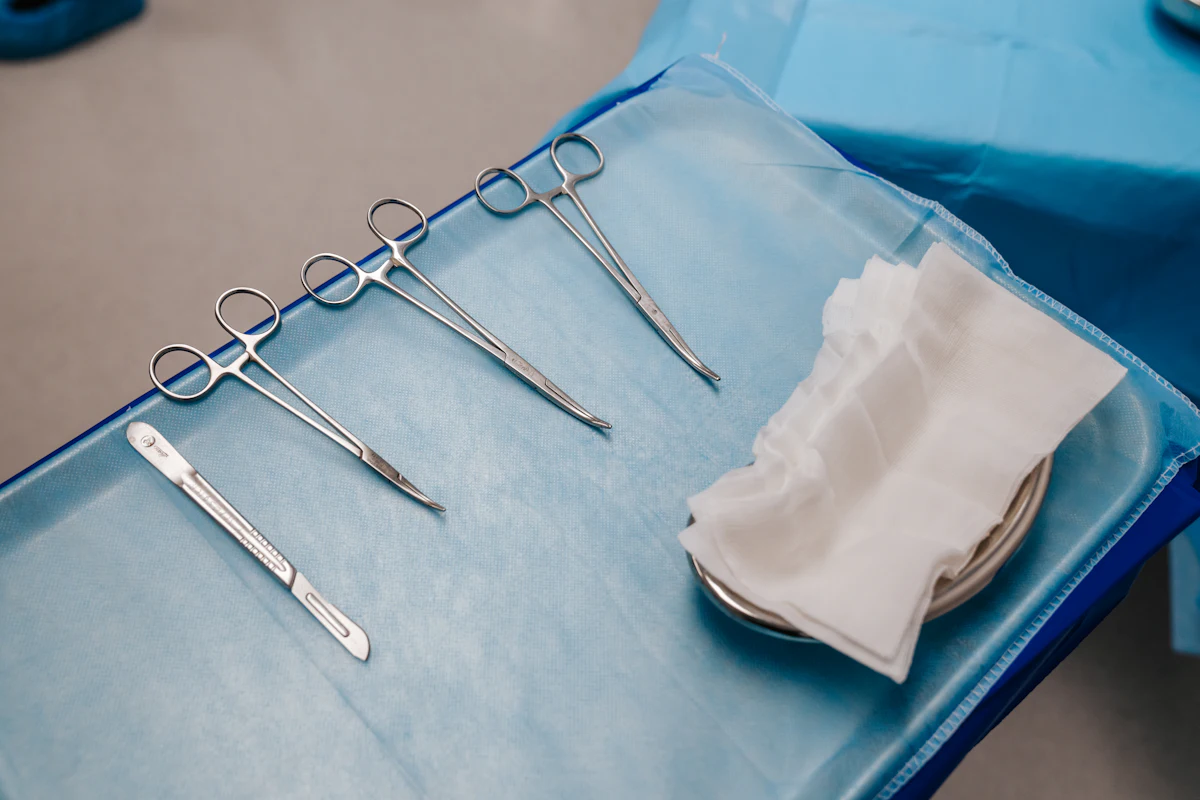
A hemostat is a scissor-like locking instrument used to control bleeding by clamping exposed blood vessels shut. It has finger-ring handles, a joint (usually a box lock), and a ratchet of interlocking teeth near the rings. The ratchet holds the jaws closed once applied and lets the user set the clamping force step by step. Wikipedia’s hemostat article notes that, early in an operation, the incision is often lined with hemostats on vessels waiting to be tied off.
The idea of clamping a vessel before tying it is old. Wikipedia credits Galen with the concept, Ambroise Paré with a 16th-century predecessor called the “crow’s beak”, and Jules-Émile Péan as the foremost figure behind the modern instrument, with later refinements by surgeons such as William Halsted. That is why “pean” is still used as a general name for a hemostat in many countries.
The named patterns differ mainly in three ways:
- Size: overall length and how fine the jaws and tips are
- Serration: whether the grooves on the jaws run the full length or only part of it
- Tips: smooth serrated tips, or tips with teeth (as on the Kocher)
All four patterns in this guide are made straight and curved.
Quick comparison
| Pattern | Relative size | Jaw serration | Typical role |
|---|---|---|---|
| Halsted mosquito | Smallest, finest tips | Fine transverse serrations along the full jaw | Small vessels and delicate tissue |
| Crile | Medium | Transverse serrations along the full jaw | Grasping vessels or tissue that will be tied off; blunt dissection |
| Kelly | Medium, often similar in length to the Crile | Transverse serrations on the distal part of the jaw only | Larger vessels and tissue |
| Rochester-Pean | Larger and heavier; long versions made | Transverse serrations along the full jaw | Vessels and tissue, including deep fields (long versions) |
Serration and size descriptions are typical catalogue descriptions, not a standard. Makers differ, so always check the product drawing or catalogue photograph.
Halsted mosquito forceps
The mosquito is the smallest and most delicate of the common hemostats. Wikipedia’s Kelly forceps article describes the mosquito variant as more delicate, with smaller, finer tips. It is named after William Stewart Halsted, who, according to Wikipedia, was among the surgeons who refined the modern hemostat.
A common catalogue length is 12.5 cm. Médecins Sans Frontières’ supply catalogue, for example, lists straight and curved Halsted mosquito forceps at 12.5 cm. Smaller and larger sizes are also made. Mosquito forceps are used on small vessels and in fine work. Some makers also offer a 1×2 toothed version, so check the tip description.
Crile forceps
The Crile hemostat, named after American surgeon George Washington Crile, is a medium-sized pattern. The American College of Surgeons’ student guide to common instruments describes it as a “snap”: an atraumatic, non-toothed clamp used to grasp tissue or vessels that will be tied off, also used in blunt dissection.
The feature that sets it apart from the Kelly is the serration. Catalogue descriptions, such as Sklar’s listings for its Crile hemostatic forceps, describe serrations along the full length of the jaw. A common length is 14 cm (5½ in), with longer versions available. The related Collier (or Coller-Crile) pattern is a Crile-type forceps with a lighter distal end.
Kelly forceps
The Kelly is named after Howard Atwood Kelly, the first professor of obstetrics and gynecology at Johns Hopkins School of Medicine. The ACS guide describes the Kelly clamp as a larger variation of the hemostat with a similar function, used for grasping larger tissues or vessels. Wikipedia notes that Kelly forceps can be used to occlude vessels, manipulate tissue, and for other purposes in both human and veterinary surgery.
In catalogues the Kelly is often the same length as the Crile, about 14 cm, which is why the two are so easily confused. The difference is in the jaw: Kelly serrations usually cover only the distal part of the jaw, leaving the part nearest the box lock smooth. Covetrus’ product listing, for example, describes the Kelly as having shorter serrations than the Rochester-Pean. Some sources describe the serrated section as about half the jaw, others a larger share, so look at the jaw itself.
Rochester-Pean forceps
The Rochester-Pean belongs to the Pean family and is the heaviest of the four. Its jaws are wider and longer, with transverse serrations along their full length. Like other hemostats, it is used to clamp vessels and tissue. Very long, straight versions are made for deep operating fields. On our Rochester-Pean hemostat page, the catalogued examples are 30 to 41 cm long and grouped with bariatric instruments.
Do not confuse it with other “Rochester” patterns, such as the Rochester-Carmalt or the Rochester-Ochsner, which have different jaw designs. Check the full name in the catalogue.
A note on the Kocher
The Kocher (or Kocher-Ochsner) looks like a heavy hemostat but has 1×2 interlocking teeth at the tip as well as serrated jaws. The ACS guide describes it as a traumatic toothed clamp used to hold tissue that will be removed. Médecins Sans Frontières’ catalogue lists a 14 cm Kocher with 1×2 teeth and heavily serrated jaws for haemostasis, dissection and gripping. Because of the teeth, it is not interchangeable with the four atraumatic patterns above. See our Kocher-Ochsner hemostat page.
How to tell them apart
- Size first. If it is small with very fine tips, it is probably a mosquito. If it is large and heavy with wide jaws, it is probably a Rochester-Pean.
- Then the serrations. For a medium hemostat, open the jaws and look at the grooves. Serrations along the whole jaw suggest a Crile. Serrations only on the distal part suggest a Kelly.
- Then the tips. Teeth at the tip mean a Kocher-type clamp, not a plain hemostat.
If in doubt, the engraving on the shank usually gives the maker and catalogue number, which you can look up.
What to check when ordering
- Pattern name: names vary. “Pean”, “Kelly”, “Rochester-Pean” and “Pean-Kelly” are not used consistently between countries and makers.
- Length: in cm or inches, as listed by the maker.
- Shape: straight or curved, and for some patterns, angle of curve.
- Jaw: full or partial serration, transverse or longitudinal, with or without teeth.
- Material and grade: reusable stainless steel versions for operating rooms, or lower-grade and single-use versions. Some suppliers, Sklar among them, sell the same pattern at several quality grades.
Our catalogue reading guide covers these fields in more detail.
Browse the patterns
See the general hemostat page for the wider family, the Collier hemostat, and all clamps in the database. Needle holders such as the Mayo-Hegar use the same ring-handle and ratchet design but have short, textured jaws for gripping a needle.
This article is general reference information about instrument design, not clinical guidance.
Sources
- American College of Surgeons, Division of Education: Common Surgical Instruments (student module)
- Wikipedia: Hemostat
- Wikipedia: Kelly forceps
- Médecins Sans Frontières Unicat: Forceps, artery, Halsted-Mosquito, 12.5 cm, straight
- Médecins Sans Frontières Unicat: Forceps, haemostatic, Kocher, 14 cm, 1×2 teeth, straight
- McKesson: Sklar 17-3055 Crile Hemostatic Forceps listing
- Covetrus: Kelly hemostat forceps product listing
More resources
Guide to Medical and Surgical Instrument Trade Fairs
MEDICA, COMPAMED, WHX Dubai, CMEF, WHX Miami, IDS, AAOS and more: what each fair covers, next dates on our calendar, and how to choose.
Read article
Tuttlingen: Germany’s Surgical Instrument Cluster Explained
How Tuttlingen grew from ironworks and knife smiths into a medical technology centre, its size, MedicalMountains, and links with Sialkot.
Read article
Sialkot’s Surgical Instrument Industry: History and Structure
How Sialkot became a surgical instrument centre, how its cluster of factories, vendors and subcontractors works, and the pressures it faces.
Read article